
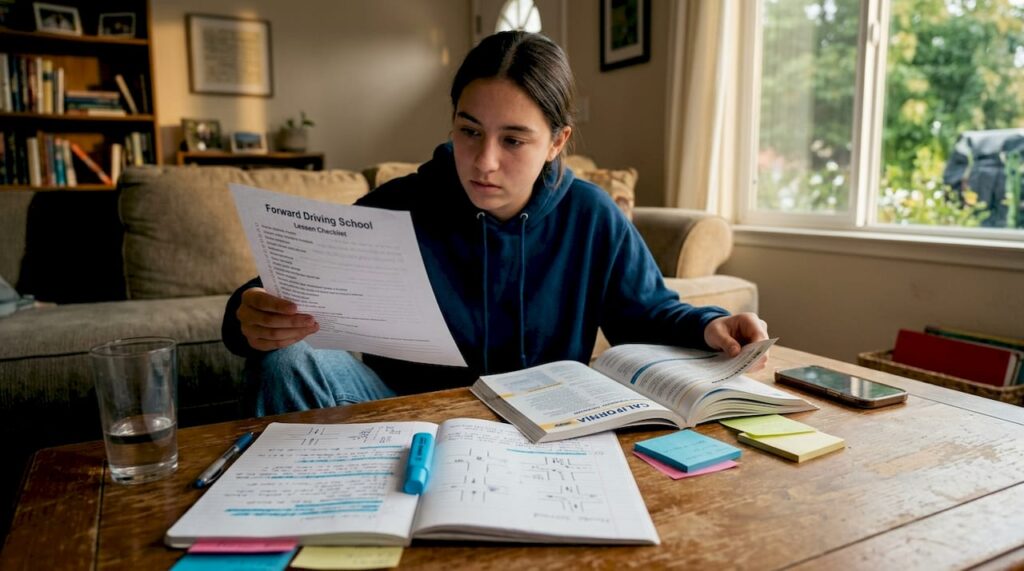
One overlooked item on your DMV pre-drive inspection can cost you weeks of waiting and another appointment fee. That’s not a worst-case scenario; it happens to new drivers in San Jose every single day. The California DMV’s Teen Driver Roadmap recommends using the Safe Driver Checklist alongside the driver handbook to prepare for both the knowledge and behind-the-wheel tests. This article walks you through a structured, four-step checklist covering vehicle readiness, control skills, scanning habits, and official resources, so you walk into your test prepared for everything the examiner looks for.
Table of Contents
- Checklist step 1: Vehicle readiness and safety inspection
- Checklist step 2: Vehicle control skills and maneuvers
- Checklist step 3: Scanning and traffic verification habits
- Checklist step 4: Referencing official DMV resources for California rules
- The overlooked driver lesson secret: Preparing for verification under real stress
- Next steps: Structured lessons and resources you can use
- Frequently asked questions
Key Takeaways
| Point | Details |
|---|---|
| Pre-drive safety matters | Vehicle safety inspection failures can force you to reschedule your driving test, so check everything ahead of time. |
| Separate skills for success | Master both control skills and scanning habits during lessons—they’re scored separately by examiners. |
| Verification under pressure | Practice verifying traffic during stressful scenarios, as this is crucial to passing in San Jose. |
| Use official resources | Rely on California DMV checklists and handbook for accurate test preparation and rules. |
| Lesson structure maximizes readiness | A structured lesson checklist boosts your test-day confidence and improves pass rates. |
Checklist step 1: Vehicle readiness and safety inspection
The examiner’s job starts before you ever touch the gas pedal. The first thing they assess is whether the car you brought is actually safe and legal to drive on a California road. This is called the pre-drive safety inspection, and it is non-negotiable.

According to DMV car requirements for 2026, if your vehicle fails any safety item during the pre-drive checklist, your test will be rescheduled. You do not get a chance to fix it on the spot. You leave, come back another day, and lose your appointment slot. That is a completely avoidable situation.
Here is exactly what the examiner checks during the pre-drive inspection:
- Mirrors: All three mirrors (left, right, and rearview) must be present, intact, and adjustable.
- Turn signals: Front and rear turn signals must flash correctly on both sides.
- Brake lights: All brake lights must illuminate when the pedal is pressed.
- Tires: Tires must be properly inflated with no visible damage or excessive wear.
- Horn: Must produce an audible sound when pressed.
- Parking brake: Must engage and hold the vehicle when applied.
- Windshield wipers and defroster: Wipers must clear the windshield, and the defroster must function.
- Doors: All doors must open, close, and latch properly from the inside and outside.
- Seat belts: Both the driver and front passenger seat belts must be present and functional.
Failing even one of these items means your test is over before it starts. Understanding vehicle safety check requirements ahead of time puts you far ahead of drivers who assume their car is “fine.”
| Inspection item | Common failure cause | How to check before test day |
|---|---|---|
| Brake lights | Burned out bulb | Have someone stand behind the car while you press the pedal |
| Tires | Low pressure or visible wear | Check PSI with a gauge; look for cracks or bald patches |
| Turn signals | Faulty fuse | Activate each signal and walk around the vehicle |
| Windshield wipers | Worn rubber blades | Test wipers at all speeds in a parking lot |
| Horn | Electrical issue | Press the center of the steering wheel and listen |
Pro Tip: Walk around your car before every driving lesson, not just on test day. Making this a habit means you will catch small problems like a broken tail light or a low tire days before they become a test-day disaster. The behind-the-wheel lesson advantages of training in a properly maintained school vehicle include never having to worry about a failed inspection on test day.
Checklist step 2: Vehicle control skills and maneuvers
With vehicle readiness covered, the next focus is mastering control skills behind the wheel. This is where most new drivers spend the bulk of their lesson time, and for good reason. Your ability to control the car smoothly and predictably is one of the clearest signals to an examiner that you are ready for a license.
California DMV scoring criteria makes an important distinction: your lesson checklist should separate vehicle control skills (smooth acceleration, braking, and steering) from scanning and verification habits. Both are evaluated independently, and doing well in one does not compensate for poor performance in the other.
Vehicle control skills to practice in every lesson include:
- Smooth acceleration: Pressing the gas gradually from a stop, no jerking or lurching forward.
- Controlled braking: Applying brakes early enough to slow the car gently, not at the last second.
- Steering control: Keeping the wheel steady through turns and lane changes, no overcorrecting.
- Speed management: Matching posted speed limits accurately, neither creeping below nor drifting above.
- Lane positioning: Staying centered in your lane, maintaining consistent distance from lane lines.
- Reverse and backing: Moving slowly and deliberately, checking mirrors and surroundings the entire time.
- Three-point turn: Executing clean direction changes with appropriate speed and situational awareness.
- Parking: Parallel, perpendicular, and angle parking with smooth inputs and accurate positioning.
The benefits of behind-the-wheel lessons include getting real-time instructor feedback that helps you identify which of these skills need the most work. Many new drivers feel confident about braking until an instructor points out they are waiting until the last 20 feet before applying pressure. That kind of feedback is impossible to get from online videos or reading alone.
A quality drivers ed course will break each of these skills into distinct practice stages so you build muscle memory gradually. The key is to isolate each skill during early lessons rather than trying to combine all of them at once in traffic. Practice smooth acceleration in an empty parking lot. Practice controlled braking on a quiet street. Then start putting them together in real traffic conditions.
Pro Tip: Treat each skill as its own mini-lesson. During your first few sessions, pick two or three items from the list above and focus only on those. Once they feel natural, layer in the next two. This staged approach reduces overwhelm and builds lasting confidence faster than trying to do everything at once.
Checklist step 3: Scanning and traffic verification habits
Once you have built confidence in basic vehicle operation, you need to integrate scanning and verification habits into every maneuver. This is the part of driver training that surprises most new drivers because it feels abstract until you understand exactly what the examiner is looking for.
Traffic checks and verification behaviors are expected during the road test. The examiner is watching whether you signal, yield, observe, and verify. That last word matters. Verifying means physically turning your head to confirm what your mirrors are showing you. Mirrors alone are not enough.
Here is what you should check during each major maneuver:
- Before changing lanes: Check the rearview mirror, then the side mirror, then turn your head and look over your shoulder at the blind spot. Signal before you move.
- Before turning at an intersection: Check all approaching lanes, look for pedestrians in the crosswalk, check for cyclists on your right when turning right.
- Before merging onto a freeway: Use mirrors to assess traffic speed and spacing, turn your head for a final blind spot check, then match speed and merge smoothly.
- At stop signs and red lights: Scan left, right, and left again before proceeding. Do not just look; make the head movement visible and deliberate.
- When backing up: Turn your body to look through the rear window directly, not just through mirrors. Check both side mirrors too.
“Looking over your shoulder is not just a habit, it is a scored behavior. When you turn your head visibly during a lane change or merge, you are showing the examiner you know your mirrors have limits. That is exactly what a passing driver does.” — Instructor perspective at Forward Driving School
For step-by-step San Jose driving tips, start practicing these head checks even when driving in low-traffic areas. If you only do them when you feel pressure, they will not feel natural during the test. Make them automatic. The more robotic and consistent your verification habit is in practice, the more fluent it will look when it actually counts. Reading through DMV test recommendations also gives you a clearer picture of how examiners score these behaviors.
Checklist step 4: Referencing official DMV resources for California rules
With your personal checklist for skills and habits in place, you need to verify everything against official California DMV materials. This is a step many new drivers skip, usually because they assume a checklist they found online is accurate enough. That is a risky assumption.
The California DMV Safe Driver Checklist and related resources are the most authoritative and up-to-date references for test preparation. They reflect exactly what the DMV expects from you during the road test, not what someone guessed based on a test they took in another state or years ago.
The California Driver Handbook (DL 600) is the primary official reference for driving rules and safe practices. Every traffic law, right-of-way rule, and safe driving behavior referenced in the knowledge test and behind-the-wheel exam comes directly from this document.
Essential official DMV resources to bookmark:
- California Driver Handbook (DL 600): Covers all traffic laws, road signs, safe driving practices, and test expectations.
- Safe Driver Checklist: A structured checklist aligned with the road test scoring sheet.
- Teen Driver Roadmap: Guides teens through every step from permit to license, including test prep resources.
- DMV practice knowledge tests: Available online through the DMV portal to simulate the written test.
| Resource type | Accuracy for CA test | Coverage of required maneuvers | Updated regularly |
|---|---|---|---|
| Official CA DMV handbook | Very high | Complete | Yes |
| DMV Safe Driver Checklist | Very high | Complete | Yes |
| Third-party driving checklists | Variable | Often incomplete | Rarely |
| YouTube tutorials | Variable | Inconsistent | No guarantee |
For California permit test help and behind-the-wheel readiness, always cross-reference what you practice in lessons against the official DMV handbook. Third-party checklists and social media tips can be useful starting points for identifying what to work on, but they should never replace the DMV’s own materials. The California DMV test recommendations page breaks down exactly what the scoring process looks like so you know what you are being graded on.
The overlooked driver lesson secret: Preparing for verification under real stress
Here is something we see consistently after more than a decade of training new drivers in San Jose: you can have every item on your checklist memorized, practice every maneuver in parking lots until it feels effortless, and still freeze up when it matters most.
The reason is stress. Test-day pressure changes how your brain processes information. New drivers who have only practiced in calm, predictable conditions often miss blind spot checks during the actual exam, not because they forgot to do them, but because they are managing nerves, listening to instructions, and handling real traffic simultaneously.
Verification under pressure scenarios are worth building deliberately into your practice sessions. A classic example: you check your mirrors before changing lanes, the lane looks clear, but there is a fast-moving car in your blind spot that your mirrors did not catch. If your head-check habit is automatic, you catch it. If it only happens when you are calm and focused, you might miss it when nerves are running high.
The conventional advice is to practice maneuvers until they feel natural. We go further. Practice them while managing distractions. Ask your instructor to give you a direction change at the last moment. Have them point out a sign while you are mid-merge. Practice lane changes when traffic is actually present, not just when the road is empty. These small stress injections during lessons are the closest thing to a test simulation you will get before the real thing.
This is not about making lessons harder for its own sake. It is about closing the gap between how you drive when relaxed and how you drive when it counts. The behind-the-wheel lesson tips that matter most are the ones that simulate real conditions, not ideal ones. If you have always felt comfortable in practice but nervous in tests, this is likely why.
Pro Tip: At the end of every lesson, ask your instructor to call out a surprise lane change or unexpected scenario. Even one or two of these per session builds the kind of stress-tested habit that examiners see and reward.
Next steps: Structured lessons and resources you can use
You now have a four-step checklist that covers everything from vehicle inspection to stress-tested verification habits. The next move is putting it into structured practice with a qualified instructor who can give you real-time feedback and help you close the gaps.
At Forward Driving School, we have been helping San Jose teens and adults pass their California DMV tests since 2010. Our drivers ed packages are designed to reinforce exactly the checklist behaviors covered in this article, from the pre-drive walkthrough to the final parallel park. Every lesson vehicle is DMV-registered, equipped with dual brake pedals, and maintained to pass any safety inspection. We offer free pick-up and drop-off, flexible scheduling, and qualified instructors who know the San Jose test routes. Whether you are starting fresh or looking to sharpen specific skills before your test date, explore our lesson advantages and book a session that fits your schedule and your goals.
Frequently asked questions
What happens if my car fails the DMV pre-drive safety inspection?
If your car fails the safety inspection, your driving test will be rescheduled and you will need to fix all failed items before returning for a new appointment.
How can I practice verification under pressure for my driving test?
Build in surprise lane changes and distractions during your practice sessions, and focus on making head and shoulder checks automatic so they happen even when you are nervous or distracted.
Are unofficial driving checklists reliable for the California DMV test?
Third-party checklists can serve as helpful practice tools, but they may not match California DMV scoring criteria or cover all required maneuvers, so always use official DMV resources as your primary reference.
Where can I find the official California DMV driver handbook?
You can download the official driver handbook directly from the California DMV website; it covers all traffic laws, road signs, and safe driving expectations used in both the written and road tests.