
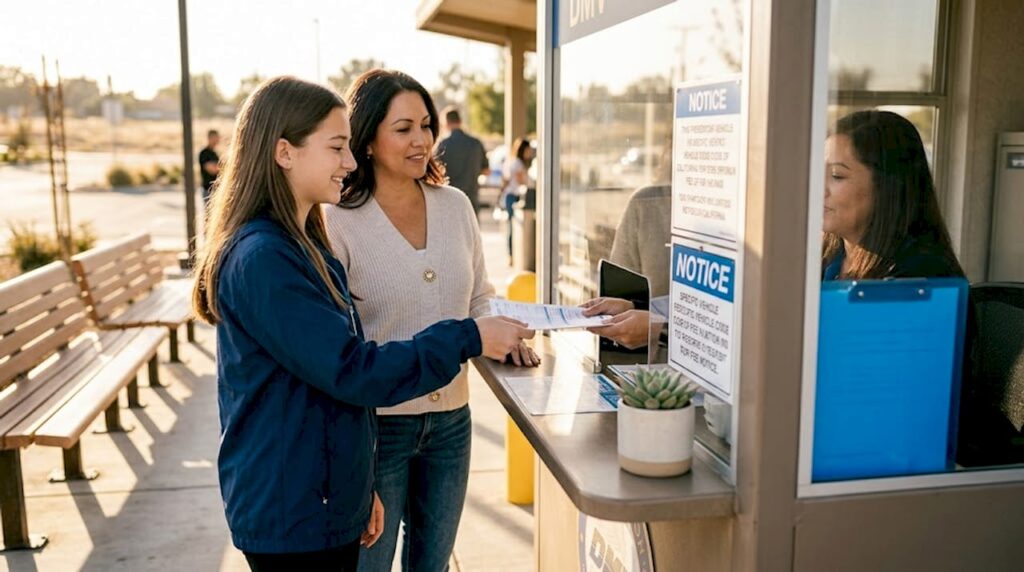
Missing a single DMV requirement can push your licensing timeline back by weeks, sometimes months. A forgotten certificate, wrong documentation, or a misunderstood supervisor age rule can send you home empty-handed after a long wait. California has a detailed, layered licensing process with different rules for teens and adults, and every step depends on completing the one before it. This guide walks you through every requirement, checklist, and deadline so you never face an avoidable delay on the way to your California driver’s license.
Table of Contents
- Understanding California driving requirements
- Step-by-step: From education to permit
- Logging practice hours and training
- Passing DMV tests and meeting vision standards
- Provisional license restrictions and final steps
- What most guides miss: Navigating California driving requirements without hidden setbacks
- Next steps: California driving courses and resources
- Frequently asked questions
Key Takeaways
| Point | Details |
|---|---|
| Key prerequisites | Teens must complete driver education, adults need a permit if unlicensed. |
| Practice requirements | Teens must log 50 supervised driving hours, including 10 at night. |
| Testing standards | All new and renewing applicants must pass DMV vision and road tests. |
| Provisional restrictions | Teen drivers face nighttime and passenger limits during their first year. |
| Edge-case issues | Missing paperwork or supervisor age can delay your license—always double-check requirements. |
Understanding California driving requirements
California structures its licensing process differently depending on your age. Understanding which path applies to you is the very first thing to get right.
Teens under 18 follow a phased approach that includes driver education, a learner’s permit, supervised practice hours, and a provisional license period. Teens must complete classroom or online driver education and receive a certificate of completion before applying for a learner’s permit. Skipping or rushing that education step means you simply cannot apply.
Adults 18 and older without any prior license also need to start from a permit. California DMV requires anyone without a California or other-state driver’s license to apply for an instruction permit before taking the behind-the-wheel drive test. It is a critical step many adults overlook, assuming the rules only apply to teens.
Here is a quick comparison of both paths:
| Requirement | Teens (under 18) | Adults (18+, no prior license) |
|---|---|---|
| Driver education course | Required (certified course) | Recommended, not mandated |
| Instruction permit | Required | Required |
| Supervised practice hours | 50 hours (10 at night) | Not mandated by hours |
| Provisional license period | 12 months minimum | No provisional period |
| Minimum permit holding period | 6 months | No minimum hold time |
Before starting any DMV application, make sure you can check off every prerequisite that applies to you:
- Valid proof of identity and residency
- Social Security number (if eligible)
- Certificate of completion for driver education (teens)
- Application fee payment
- Parental consent form (teens)
You can get started on your education through drivers ed courses designed to meet California DMV standards, and check teen permit information to know exactly what to bring to the DMV. It also helps to stay current on the latest driving rules before you apply.
Step-by-step: From education to permit
Having clarified the requirements, it is time to map out the exact steps to move from learning to holding your permit. Each step builds on the last, and the order matters.
Here is the numbered process from start to permit:
- Enroll in a certified driver education course. For teens, this is non-negotiable. The teen roadmap confirms that teens must receive a certificate of completion before any permit application. Choose a course that is recognized by the California DMV.
- Study the California Driver Handbook. The DMV provides official education resources including links to driver training schools and preparation guides. Use them seriously.
- Schedule your DMV knowledge test appointment. Waiting until the last minute means longer delays. Book early.
- Gather all required documents. Identity documents, proof of residency, Social Security card, and your driver education certificate (teens) must all be in hand before you walk in.
- Pass the vision and knowledge tests at the DMV. Both are administered at the same visit. Failing either means you walk out without a permit.
- Receive your instruction permit. Once you pass, you can officially begin supervised driving practice.
Our online drivers ed guide breaks down what to expect from the education phase, and our permit test prep resource can help you feel ready before you ever step into a DMV office.
Pro Tip: Do a full document check the night before your DMV visit. Many applicants fail to bring the right form of proof of residency and have to reschedule. Use the DMV’s online checklist to verify every document, every time.
Logging practice hours and training
After permit acquisition, supervised practice and training are the next big steps. What you track and who is in that passenger seat matters enormously.

California’s rules on supervised driving practice are strict and specific. Before taking the behind-the-wheel test, teens must complete at least 50 hours of supervised practice, including 10 hours specifically at night. They must also hold the permit for at least 6 months and be at least 16 years old. Every single one of those conditions must be met before a test can be scheduled.
Here is a breakdown of the practice requirements:
| Practice type | Required minimum | Notes |
|---|---|---|
| Total supervised driving hours | 50 hours | Logged and signed by supervising driver |
| Nighttime driving hours | 10 hours | Must be driven between dusk and dawn |
| Permit holding period | 6 months | Clock starts from date of issue |
| Minimum applicant age for test | 16 years old | No exceptions |
Who sits beside you also matters. The California driver handbook is clear that the supervising driver must be California-licensed and at least 25 years old when supervising a minor. Many families assume an 18-year-old sibling can supervise, but that is incorrect for permit holders under 18. Getting this wrong can invalidate logged hours and cost weeks of progress.
Practical tips for logging practice hours without trouble:
- Use the official California DMV log sheet and fill it in after every drive, not in batches later
- Make sure your supervising driver signs each entry with the correct date
- Deliberately schedule night driving sessions early rather than leaving 10 hours to cram in at the end
- Practice in diverse conditions: highway merging, residential streets, school zones, and heavy traffic areas
- Keep the log sheet stored with your permit so it is always on hand
Pro Tip: Build night driving practice into a weekly routine from the second month of permit holding. Teens who save all 10 nighttime hours for the final weeks often feel underprepared and nervous. Consistent, spread-out practice builds the real-world confidence that translates directly to a better test outcome.
Read the teen driver transition guide for a fuller picture of how to progress confidently through each phase, and explore the behind-the-wheel lessons available to make the most of your practice time.
Passing DMV tests and meeting vision standards
Once you have completed education and practice, it is time for DMV testing. Both your skills and your vision must meet California standards, and failing to prepare for either can end the visit before it starts.
California requires all driver’s license applicants to pass a vision screening, not just teens. All new and renewing applicants must meet the standard of 20/40 with both eyes, or 20/40 in one eye and at least 20/70 in the other. The DMV may also require a vision test based on age or driving record, even for renewals.
“California’s vision standard requires 20/40 vision with both eyes open, or 20/40 in one eye and at least 20/70 in the other. Corrective lenses are permitted, but your license will note the restriction.”
Common mistakes that derail both first-time and returning applicants at testing:
- Arriving without corrective lenses when glasses or contacts are normally worn
- Failing the vision test because of an undiagnosed or uncorrected change in eyesight
- Going into the knowledge test without reviewing the current California Driver Handbook (it is updated regularly)
- Scheduling a behind-the-wheel test before completing all 50 supervised hours
- Bringing a vehicle without the required insurance or registration documents for the road test
For the behind-the-wheel test itself, the examiner evaluates turns, lane changes, speed management, intersections, and general situational awareness. Nervousness causes most failures, not lack of skill. The best cure for nervousness is genuine preparation.
Review our DMV test recommendations for a practical breakdown of what examiners look for, and use the knowledge exam guide to test yourself before the real thing.
Provisional license restrictions and final steps
With your tests complete, understanding the post-licensing rules is crucial to keeping your new license and avoiding a setback that could trigger a suspension or violation.
Teen drivers who pass their behind-the-wheel test receive a provisional license, not a full license. That distinction carries real restrictions. During the first year as a provisional driver, teens cannot drive between 11 p.m. and 5 a.m., and they may not transport passengers under 20 years old unless a licensed driver who is 25 or older is present.
“Violating provisional license restrictions can result in a citation, points added to your driving record, and in some cases, a suspension of the provisional license itself. A clean first year builds a clean record.”
Key restrictions to know during the provisional period:
- No driving between 11 p.m. and 5 a.m. (exceptions apply for work or school with a signed note from a parent and employer or school official)
- No passengers under 20 years old without a supervising licensed driver 25 or older present
- All standard traffic laws still apply, including seatbelt requirements for all occupants
- Cell phone use while driving is prohibited regardless of license type
After 12 months of clean provisional driving and turning 17, teens can drive without these restrictions. The final step toward a full unrestricted license is simply time and a clean record. There is no additional test required.
Adults who complete the process, including permit, knowledge test, vision test, and behind-the-wheel test, receive a full license without any provisional period. For more detail on how the provisional license transition works, including timelines and what counts as a violation, that resource covers everything cleanly.
What most guides miss: Navigating California driving requirements without hidden setbacks
Most guides cover the steps. Fewer address what actually trips people up in practice, and that gap causes real frustration.
The biggest pattern we see at Forward Driving School is not ignorance of the rules but incomplete preparation for the edge cases. A parent genuinely believes their 22-year-old can supervise their 16-year-old because that parent is working, and it seems logical. The rule says 25, and suddenly weeks of logged hours are in question. A teen shows up to the DMV with a printed certificate from an online course that was not DMV-approved. The application stalls.
These are not rare scenarios. They happen constantly, and they share a common cause: treating the licensing process as a checklist to check off rather than a system where every detail is verified.
The documentation mindset is genuinely underrated. Before every DMV visit, before every supervised practice session, before scheduling any test, ask yourself whether you can physically prove each requirement has been met. Can you show the signed log sheet? Is the certificate from an approved provider? Does your supervising driver have their license on them?
We also notice that many new drivers and their parents do not stay current on legislative changes. California updates its driving laws periodically, and what was true two years ago may have changed. One practical habit: check the DMV website or review materials from a reputable driving school before your test date to confirm no new requirements have slipped in. Following the teen driver step-by-step process through a structured program helps guard against exactly this problem.
The drivers who move through this process without setbacks are not necessarily more talented or more intelligent. They are more systematic. A quick habit of verifying before assuming will save you more time than any amount of last-minute cramming.
Next steps: California driving courses and resources
Getting through California’s licensing requirements is far smoother when you have expert guidance backing you up every step of the way.
At Forward Driving School, we have helped San Jose area teens and adults navigate this process since 2010. Our California drivers ed programs are fully registered with the California DMV and designed to satisfy every education requirement from the start. Whether you are a teen working toward your first permit or an adult who needs a structured path to a first license, our courses are built around your schedule and your goals. For adults specifically, our adult drivers ed program combines safety skills with real confidence building, so you feel prepared long before test day arrives. Reach out today and take the guesswork out of the process entirely.
Frequently asked questions
How many hours of driving practice do California teens need before getting a license?
California teens need at least 50 hours of supervised driving practice, including 10 hours at night, before they can take the behind-the-wheel DMV test.
What age must a supervising driver be for California teen permit holders?
Supervising drivers for teen permit holders must be California-licensed and at least 25 years old when the permit holder is a minor.
What vision standards must you meet for a California driver’s license?
You must meet DMV vision standards of 20/40 with both eyes, or 20/40 in one eye and at least 20/70 in the other, with or without corrective lenses.
What are the nighttime and passenger restrictions for provisional teen drivers?
Provisional teen drivers cannot drive between 11 p.m. and 5 a.m., and may not carry passengers under 20 unless a licensed driver who is 25 or older is present in the vehicle.
Do adults also need to apply for an instruction permit if they don’t already have a license?
Yes, adults without a California or other-state license must apply for an instruction permit before scheduling or taking the behind-the-wheel drive test.