
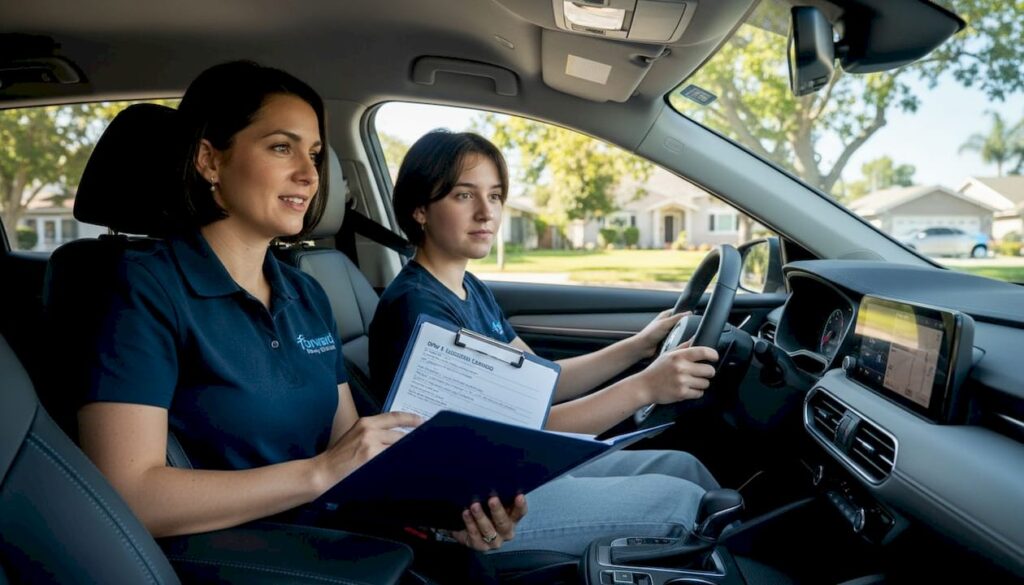
Picking a driving school feels straightforward until you realize that handing your teen over to the wrong instructor carries real legal and safety consequences. Many families assume any adult with a car and patience qualifies to train a new driver, but California DMV requires teens under 18 to complete a DMV-approved driver education program and behind-the-wheel training with a licensed school or instructor. This article breaks down exactly what certified instruction means, why it is legally required, and how it shapes long-term driving safety for every teenager learning to drive in San Jose.
Table of Contents
- What does ‘certified driving instructor’ mean in California?
- Legal requirements: Why certified instruction is a must for San Jose teens
- How certified instructors help keep teens safer
- What to look for: Choosing the right certified driving instructor
- Why instruction quality matters more than most parents realize
- Ready to get started? Explore certified instruction options in San Jose
- Frequently asked questions
Key Takeaways
| Point | Details |
|---|---|
| Certification is required | California law mandates certified instructors for teens seeking a driver’s license. |
| Safety beyond legal minimums | Certified instruction reduces teen crash risk by up to 70% after licensing. |
| Choose instructors wisely | Look for both DMV certification and teaching methods focusing on risk awareness and safe decision-making. |
| All instruction quality is not equal | Not all education reduces accidents, so prioritize programs aligned with real-world safety outcomes. |
What does ‘certified driving instructor’ mean in California?
Not all driving instructors are created equal, and in California the difference between a certified and an uncertified instructor is not just a technicality. A certified instructor holds an active license issued by the California DMV, and earning that license is not a quick process. It requires background checks, a thorough knowledge exam covering current traffic law, and demonstrated mastery of teaching methods and techniques. The state’s instructor certification process confirms that certified instructors understand safe driving practices as well as the science of how people learn to drive.
That last part matters more than most parents expect. Knowing how to drive is one skill. Knowing how to teach driving to a nervous 16-year-old is an entirely different one. Certified instructors are trained to structure lessons progressively, give feedback without creating panic, and recognize the specific errors that tend to produce crashes in new drivers. An uncertified “instructor” such as a parent’s colleague or a neighbor who charges a small fee has none of that verified training.
Here is a clear side-by-side comparison of the two categories:
| Feature | Certified DMV-licensed instructor | Uncertified instructor |
|---|---|---|
| DMV license required | Yes | No |
| Background check completed | Yes | Not required |
| Traffic law knowledge verified | Yes | Unknown |
| Teaching methods training | Yes | None confirmed |
| Can sign off on instruction log | Yes | No |
| Qualifies teen for license pathway | Yes | No |
| Curriculum aligned with DMV standards | Yes | Not guaranteed |

For any teen working toward their first California driver’s license, the bottom line from the California Driver Handbook is simple: only a DMV-licensed school or instructor counts toward the required training hours. You can find a complete overview of drivers ed requirements to understand exactly what is needed before your teen steps behind the wheel.
Key benefits of choosing a certified instructor include:
- Legal compliance: All training hours count toward state requirements.
- Structured curriculum: Lessons follow a sequence designed for skill progression.
- Consistent feedback: Instructors are trained to correct habits early, before they become dangerous.
- Accountability: Licensed instructors are subject to DMV oversight and can lose their license for misconduct.
- Peace of mind: Parents know their teen is learning from someone the state has vetted.
If you want to understand the full picture before enrolling, the online drivers ed details page explains how classroom and online formats both fit into the overall certification process.
Legal requirements: Why certified instruction is a must for San Jose teens
Understanding certification is only the first step. Next, let’s see how it fits into the legal process to get a teen licensed in San Jose. California’s graduated driver licensing (GDL) system sets out a clear pathway, and skipping any part of it means your teen cannot legally get a license.
Here is the required sequence for teens under 18:
- Complete DMV-approved driver education. This can be done online or in a classroom, but the provider must be DMV-licensed. This covers traffic laws, road signs, and safe driving principles.
- Obtain a provisional instruction permit. Your teen can apply for the permit after passing the knowledge test at the DMV. They must be at least 15 and a half years old.
- Log 50 hours of supervised practice driving. At least 10 of those hours must be at night. While parents or guardians handle much of this, the professional training hours still count.
- Complete at least six hours of behind-the-wheel training with a certified instructor. This is not optional. The Teen Driver Roadmap confirms that a DMV-licensed driving school or instructor must be part of the licensing pathway.
- Hold the permit for at least six months before taking the road test.
- Pass the California DMV road test with a licensed examiner.
“A California DMV-licensed driving school or instructor is a mandatory part of the teen licensing process, not an optional upgrade.”
Parents sometimes believe that extra practice with a parent or guardian can substitute for the professional hours. It cannot. Those six certified hours serve a specific legal function: they validate that the teen received structured, qualified instruction before sitting for the road test.
Pro Tip: Schedule your teen’s certified lessons earlier in the permit period, not right before the road test. Earlier instruction builds correct habits that the 50 practice hours reinforce, rather than spending those hours fixing mistakes that were never properly addressed.
Families who understand the complete teen licensing path from the start avoid costly delays and last-minute scrambles at the DMV. For a step-by-step breakdown of what to expect on test day, the California driving test steps page is a reliable resource.
How certified instructors help keep teens safer
Meeting legal requirements is essential, but real peace of mind comes from knowing your teen is safer on the road. Here is how certified instructors make a concrete difference for your family’s safety.
The data on this point is striking. Teens who completed GDL-mandated driver training had approximately 70% lower odds of being involved in severe crashes one year after getting their license. That is not a small margin. It is the difference between a statistic and a story you never have to tell.
However, not every form of driving education produces the same result. A Cochrane review on driver education found that school-based driver education, particularly programs that are not structured around risk awareness, may not reduce crash involvement and can in some cases lead to earlier licensing without proportional safety gains. The takeaway is clear: the type of certified instruction matters just as much as the certification itself.
| Instruction type | Crash risk impact | Key strength |
|---|---|---|
| GDL-aligned certified training | 70% lower severe crash odds | Risk perception, structured progression |
| Generic classroom-only education | Minimal to no reduction | Knowledge gain only |
| Unstructured informal practice | No documented reduction | Quantity without quality |
| Certified instruction with hazard focus | Strongest outcomes | Decision-making, real-world scenarios |
What distinguishes the best certified instructors is their focus on risk perception and decision-making, not just mechanical skills like parking or lane changes. A teen who can parallel park flawlessly but freezes when a cyclist swerves into their lane is not truly road-ready. Certified instructors who teach hazard recognition, scanning techniques, and how to read traffic patterns produce drivers who can handle surprise situations safely.
Pro Tip: When evaluating a certified instructor, ask specifically whether their lessons include hazard recognition scenarios and decision-making drills. These are the skills that matter most after the road test is over.
Parents in San Jose can learn more about what this kind of instruction looks like in practice through trusted teen driving lessons, which highlights what quality instruction actually delivers. For preparation guidance, DMV test recommendations walks through the skills examiners look for on the road test.
What to look for: Choosing the right certified driving instructor
With safety and compliance in mind, here is how you can make a smart, informed choice for your teen’s driving future.
Research confirms that instruction effectiveness increases when programs focus on risk perception and decision-making rather than just route memorization and basic maneuvering. That finding should shape how you evaluate every instructor you consider.
What to look for:
- Current DMV license: Ask to see it. A legitimate instructor will show it without hesitation.
- Ongoing education: Good instructors stay current on California traffic law updates and teaching best practices.
- Structured lesson plans: Quality programs follow a logical skill progression rather than just driving around the neighborhood.
- Focus on risk and decisions: Ask whether lessons include scenarios involving pedestrians, cyclists, merging traffic, and night driving.
- Clear feedback methods: The best instructors explain why something is wrong, not just that it was wrong.
- Positive parent and teen reviews: Look for specific mentions of patience, clarity, and confidence-building.
- Policies for nervous students: A good instructor adapts to anxiety, especially for teens who freeze under pressure.
Red flags to avoid:
- Vague or evasive answers about credentials
- Unwillingness to show a DMV license or school certification
- A program that focuses only on passing the road test
- No structured curriculum or lesson plan
- Unusually low prices with no explanation of what is or is not included
- No vehicle safety features such as dual brake pedals
Pro Tip: Before booking, ask the instructor directly: “What do you do when a student makes a dangerous mistake?” The answer tells you a lot about their teaching style, their patience, and whether they prioritize real safety over just finishing the required hours.
For context on how current California driving rules shape what certified instructors are required to teach, the latest driving rules page keeps families informed of recent legislative changes that affect teen drivers specifically.
Why instruction quality matters more than most parents realize
Before you finalize your choice or settle for the quickest route, consider this overlooked perspective.
Most parents approach driver education as a compliance task. Find a school, check the box, get the license. That mindset is understandable, especially when coordinating around school schedules, sports, and work. But it misses the most important variable in the entire process: the quality of what happens inside those training hours.
Certification is the baseline, not the ceiling. A certified instructor who spends six hours doing laps around quiet residential streets has technically fulfilled the legal requirement. A certified instructor who uses those same six hours to expose a teen to highway merging, aggressive driver behavior, night driving, and rain conditions has done something entirely different. Both are “certified.” Only one has genuinely prepared that teenager for the roads of San Jose.
Research backs this up clearly. Evidence-aligned methodology focused on risk perception and decision-making is more consistently associated with better safety outcomes than instruction that prioritizes test performance alone. Parents who ask only about pass rates are measuring the wrong thing. A teen can pass the road test and still be dangerously unprepared for the situations the test never covers.
There is also an uncomfortable nuance worth acknowledging. The Cochrane review evidence shows that not all driver education produces better outcomes. In some cases, completing a program faster led teens to get licensed earlier, before their actual risk judgment was fully developed. This does not mean education is bad. It means that how education is delivered determines whether it creates a safer driver or simply a licensed one.
The families who get the best long-term results are those who look past the certificate on the wall and ask real questions about teaching philosophy. They want to know if the program addresses making California highways safer through real behavioral change, not just route memorization. That kind of parent advocacy, choosing quality over convenience, is one of the most protective decisions a family can make for a new teen driver.
Ready to get started? Explore certified instruction options in San Jose
If you want to set your teen up for lasting safety and confidence, your next step is easy.
At Forward Driving School, every instructor is California DMV-certified, and every program is built around the legal requirements and safety best practices described in this article. San Jose teens get structured behind-the-wheel training in dual-brake-equipped vehicles, flexible scheduling around school and activities, and free pick-up and drop-off to make enrollment as smooth as possible.
Start with a complete overview of our san jose drivers ed program to see exactly what is included in both the classroom and behind-the-wheel components. If you want to understand why in-car time with a certified instructor is so valuable, the benefits of behind-the-wheel lessons page lays it out clearly. And for a step-by-step look at how teens progress from permit to full license in this area, safe driving in San Jose walks through the entire journey. Forward Driving School has been preparing confident, safe teen drivers since 2010, and we would be glad to help your family navigate this milestone.
Frequently asked questions
Is a certified instructor required for teens to get a license in California?
Yes. For teens under 18, California DMV requires both classroom and behind-the-wheel training to be completed with a DMV-licensed school or instructor before the teen can apply for a license.
How does choosing a certified instructor impact my teen’s road test success?
Certified instructors are trained in DMV curriculum and safe driving methods, which means teens arrive at the road test knowing exactly what examiners look for. The instructor certification standards include teaching techniques and traffic law knowledge that directly translate to test readiness and real-world confidence.
Do certified instructors really reduce new driver crash risk?
Teens who complete certified, GDL-based training have about 70% lower odds of being involved in a severe crash within one year of getting their license, compared to new drivers without that structured training.
Is online drivers ed accepted if the instructor is certified?
Yes. California DMV accepts online driver education as long as the provider is DMV-licensed. The Teen Driver Roadmap includes both online and classroom options, provided both the education and the behind-the-wheel instruction come from licensed sources.