
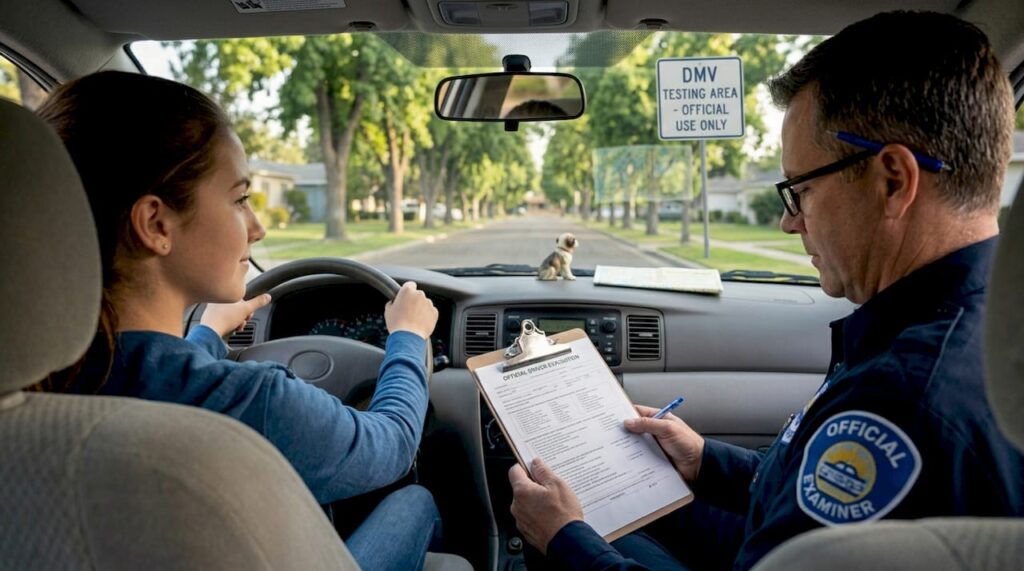
Most people think the DMV driving test is purely about whether you can drive. That assumption trips up more test-takers than any missed stop sign. What is the DMV driving test, really? It is a two-part evaluation that grades both your driving performance and the condition of the vehicle you bring. Show up with a burned-out brake light or missing insurance paperwork, and your appointment gets canceled before you ever pull out of the lot. Understanding the full scope of what the test involves gives you a real advantage before test day arrives.
Table of Contents
- Key takeaways
- What is the DMV driving test and what it covers
- Vehicle and document requirements you cannot overlook
- How scoring works and why people fail
- Practical strategies to prepare and pass
- My honest take on what actually makes the difference
- Get test-ready with Forwardschool
- FAQ
Key takeaways
| Point | Details |
|---|---|
| Two-part evaluation | The DMV driving test grades both your on-road driving skill and your vehicle’s safety condition. |
| Documents are non-negotiable | Missing registration or insurance proof cancels your test, regardless of how well you drive. |
| Consistent safety beats flashy skills | Examiners reward steady, law-abiding behavior over technically perfect isolated maneuvers. |
| Retake fees and wait times apply | States like Connecticut charge a $40 retesting fee and require a two-week wait before retesting. |
| Preparation is the real differentiator | Practicing specific maneuvers repeatedly and knowing what examiners watch for cuts test anxiety significantly. |
What is the DMV driving test and what it covers
The DMV driving test is the final step needed to receive a driver’s license after you complete your permit requirements and any mandatory training. It exists to confirm you can operate a vehicle safely under real traffic conditions, not just in a parking lot.
Most states structure the test in two clear phases. The first is a pre-drive check, where the examiner verifies your vehicle’s safety features and asks you to demonstrate things like turn signals, brake lights, horn, and windshield wipers. The second is the on-road evaluation, where you drive through actual traffic while the examiner observes your decision-making, lane discipline, and compliance with traffic laws.
The specific maneuvers vary by state, but the core list is consistent across most jurisdictions. South Carolina’s road test includes a vision screening, a vehicle safety features check, parallel parking, 100 feet of straight backing, hill parking, a three-point turn, and straight-line backing. Pennsylvania and Connecticut test similar skills with slight procedural differences, which is why understanding your specific state’s requirements matters.

One detail many first-timers miss: states require a vision test as part of the road test process. If you wear glasses or contacts while driving, bring them. Failing the vision check ends the appointment immediately.
Pro Tip: Check whether your state’s DMV publishes its exact road test scoring sheet online. Many do, and reviewing it gives you a precise list of what the examiner is watching for during each maneuver.
State-specific driving rules, including rules that affect how you drive during the test, are worth reviewing before your appointment. Resources like dashcam laws by state show how much regulations vary, which is a good reminder that your state’s driver manual is the most accurate prep tool you have.
Vehicle and document requirements you cannot overlook
Here is where many tests get derailed before a single mile is driven. Examiners will not conduct the road test if the vehicle is mechanically unsafe or if required documentation is missing. That means you reschedule, you wait, and in some states, you pay a fee to try again.
The documents you need to bring to your appointment typically include:
- Valid driver’s permit or identification
- Proof of liability insurance for the test vehicle
- Current vehicle registration card
- Any additional state-required forms or appointment confirmation
If you are using a rental vehicle, the requirements get stricter. South Carolina requires that the rental contract explicitly lists you as an insured driver. Using a friend’s or family member’s car without confirming insurance coverage can produce the same problem.
Vehicle safety is treated as seriously as driver ability. The road test is a dual assessment of both. Examiners check for functional brake lights, working turn signals, intact seatbelts, properly inflated tires, a working horn, and clean windshields. Any safety defect that could create risk during the test results in cancellation. The Forwardschool California DMV test recommendations guide covers a thorough vehicle checklist worth reviewing before your appointment.
Pro Tip: Do a full vehicle walkthrough the evening before your test. Ask someone to stand behind the car while you press the brakes and activate each signal. Catching a faulty light the night before costs nothing. Catching it at the DMV costs you the appointment.
How scoring works and why people fail
The examiner is not looking for a perfect driver. They are looking for a safe one. Consistent safe-driving behavior and strict compliance with traffic laws are what passing scores are built on. Isolated technical brilliance does not compensate for running a yellow light or failing to check mirrors before a lane change.
Pennsylvania’s DMV manual is direct about what triggers an immediate failure. The most common automatic fails include:
- Dangerous driving that puts the examiner or others at risk
- Causing or nearly causing a collision
- Disobeying a traffic control device (stop signs, signals, lane markings)
- Refusing to follow examiner instructions
- Accumulating too many minor errors in the same category
That last point matters more than most people realize. A single missed shoulder check is a minor error. Three missed shoulder checks tells the examiner you have a consistent habit, and habits like that get people hurt on real roads.
Common fail triggers in actual road tests include improper lane changes, not scanning intersections before entering, using turn signals late or not at all, incorrect speed management in school zones, and not yielding properly to pedestrians. These are not obscure rules. They are the everyday behaviors that separate safe drivers from accident risks.
Retake policies add real pressure too. Connecticut requires rescheduling within 72 hours after a failed test, mandates a minimum two-week wait before retesting, and charges a $40 retesting fee. That two-week gap is not a punishment. Use it as structured practice time focused specifically on what went wrong the first time.
Practical strategies to prepare and pass
Preparation that actually works looks different from what most people do. Most new drivers spend time driving generally around town. Effective preparation means drilling the specific maneuvers on the test until they feel mechanical, then shifting focus to how you respond to instructions.
Here is what a smart preparation plan covers:
- Practice parallel parking at least 20 times before test day. This is the maneuver that causes the most anxiety, and anxiety causes errors. Repetition removes the fear.
- Practice three-point turns on streets of different widths so you are ready for whatever road the examiner picks.
- Work on intersection behavior deliberately. Before every intersection in practice, verbalize what you are checking: mirrors, signals, oncoming traffic, pedestrians. Making this a conscious habit speeds the process of making it automatic.
- Drive with a passenger who gives verbal directions rather than taking your usual routes. The examiner will give you turn-by-turn instructions. Getting used to acting on spoken directions while continuing to drive safely is a skill worth practicing.
- Perform a vehicle safety check as part of every practice session, not just on test day. This builds the habit and removes the guesswork.
Scheduling your test at a less busy DMV location or during off-peak hours can also reduce wait stress. Online scheduling is standard in most states now. Book your appointment as soon as you feel genuinely ready, not just mostly ready.
Mental preparation is underrated. The examiner sitting next to you changes how you drive if you let it. Some test-takers slow down too much because they are nervous. Others forget to signal because they are focused on the examiner’s clipboard. Practicing with a parent, instructor, or friend riding along specifically to observe and evaluate your driving mimics that pressure. The more you practice being watched, the less it affects you.
For adults returning to the road after a gap, refresher driving lessons address exactly the habits that drift over time. Teens working toward their first license benefit from structured behind-the-wheel programs that teach responding to examiner-style instructions from day one. Review the teen driver transition guide for a clear picture of the steps from learner permit to full license.
My honest take on what actually makes the difference
I have worked with hundreds of students at different stages of preparation, from teenagers nervous about their first appointment to adults who have not driven in five years. The pattern I see consistently is this: the people who fail are almost never bad drivers. They are underprepared in specific ways that never got addressed.
What surprises first-timers most is the vehicle requirement. I have seen students practice for weeks, develop real confidence behind the wheel, and then have their appointment canceled because of a missing insurance document or a cracked taillight they never noticed. That kind of failure stings differently than a driving error because it feels entirely preventable. It is preventable. But only if you treat vehicle prep as part of your test preparation, not a separate administrative task.
The other thing I want to be direct about is this: memorizing test routes does not work, and in states where examiners change routes regularly, it backfires by creating false confidence. What actually builds real test readiness is understanding what the examiner is evaluating at each moment. When you know they are watching your intersection approach, you scan proactively rather than reactively. When you know they want to see your mirrors checked before every lane change, you build the habit instead of trying to remember it under pressure.
Adults refreshing skills need to hear that retake scheduling rules matter for planning. Knowing that a failed test in some states means a two-week wait and a fee should push your practice timeline earlier, not later. Build in enough time before your actual deadline to absorb a setback without panic.
Treat the test as a safety demonstration. That reframe changes everything.
— Andre
Get test-ready with Forwardschool
Whether you are a teen preparing for your first license or an adult getting back behind the wheel, having the right instruction makes a measurable difference in your test outcome.
Forwardschool has been preparing drivers in San Jose since 2010, with programs designed around exactly what California’s DMV evaluates. Their comprehensive driver education programs cover behind-the-wheel training, pre-test vehicle walkthroughs, and personalized coaching that addresses your specific weak points before test day. For adults returning to driving, the adult driver’s ed program rebuilds both skill and confidence at your pace. Free pick-up and drop-off, flexible scheduling, and DMV-registered dual-brake vehicles are included. Book your first lesson at Forwardschool and walk into your test appointment genuinely ready.
FAQ
What is the DMV driving test made up of?
The DMV driving test includes a pre-drive vehicle safety check, a vision screening in many states, and an on-road evaluation of maneuvers like turns, lane changes, parking, and backing. Both the vehicle’s condition and the driver’s behavior are assessed.
What documents do I need to bring to the DMV driving test?
You typically need your learner’s permit or ID, valid vehicle registration, and proof of liability insurance for the test vehicle. Missing any of these results in cancellation of your appointment.
How do I pass the DMV driving test on the first try?
Focus on consistent, safe behavior throughout the entire test rather than perfecting individual maneuvers. Practice the specific skills your state requires, drill intersection scanning and mirror checks, and confirm your vehicle is mechanically sound before your appointment.
What automatically fails you on the DMV driving test?
Automatic fails include dangerous driving, causing a near collision, disobeying a traffic device, refusing examiner instructions, and accumulating too many errors in a single category. Pennsylvania’s driver manual outlines these failure criteria explicitly.
How long do I have to wait to retake the DMV driving test?
Wait times vary by state. Connecticut requires at least two weeks before retesting and charges a $40 retesting fee. Most states also require you to reschedule your appointment online within a short window after failing.