
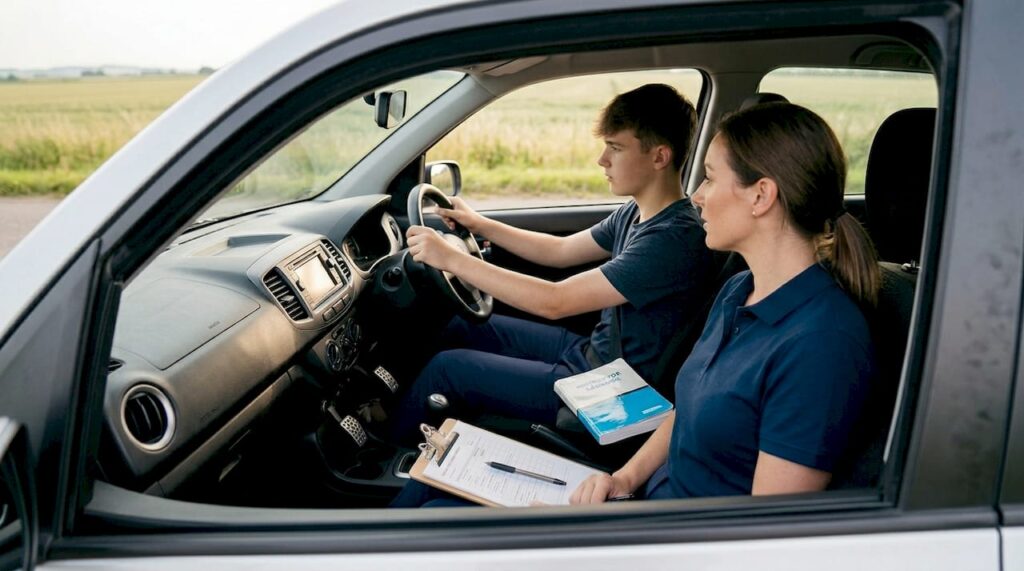
Most people assume that learning to drive is primarily about the instructor’s skill and the student’s willingness to practice. The vehicle itself? An afterthought. That assumption is wrong, and it costs learners in both time and safety. The role of driving lesson vehicles extends far beyond simply providing a machine to operate. The specific car a student trains in shapes their confidence, influences how quickly they absorb skills, and can mean the difference between an instructor catching a mistake and a close call turning into something worse. This article breaks down exactly what makes a training vehicle different from any car on the road.
Key Takeaways
| Point | Details |
|---|---|
| Vehicle type shapes learning speed | Automatic transmissions reduce instruction hours by 10–15 compared to manual, helping learners progress faster. |
| Dual-control systems are non-negotiable | A second brake pedal gives instructors the ability to intervene instantly, which is the single most important safety modification in any lesson car. |
| Vehicle ergonomics affect learner confidence | Good sightlines, responsive controls, and a manageable car size directly reduce anxiety and improve a student’s ability to focus on the road. |
| Insurance compliance matters for school vehicles | Private vehicles used for lessons may lack coverage for unlicensed drivers, making purpose-built school cars a legal and financial necessity. |
| Fleet choices reflect operational realities | Fuel economy, maintenance costs, and regulatory compliance all drive the decision toward compact sedans and emerging hybrid models. |
The role of driving lesson vehicles in driver education
The phrase “driving lesson vehicle” might sound like industry jargon, but the recognized term among professionals is instructional vehicle or dual-control training vehicle. Both phrases refer to the same thing: a car specifically prepared, modified, and selected to support structured driver education. Not every car qualifies, and the distinctions matter more than most learners realize.
A standard passenger car handed over to a student with no modifications puts the instructor in a passive seat. They can give verbal cues, but they cannot physically prevent an error from becoming dangerous. Instructional vehicles change that dynamic entirely. The most critical modification is the second brake pedal, mounted on the passenger side, which allows an instructor to apply the brakes independently of the student. That single feature reframes the entire lesson from a supervised gamble into a genuinely controlled learning environment.

Beyond the dual-control setup, the type of vehicle matters. Compact sedans dominate driving school fleets globally because they offer manageable dimensions, clear sightlines, and predictable handling. A learner placed in a large SUV or a performance vehicle faces additional variables that have nothing to do with learning the rules of the road. Keeping the mechanical complexity low lets the student focus mental energy on decision-making, awareness, and habit-building.
Common vehicle types used by driving schools
When schools evaluate what to put in their fleets, the shortlist almost always looks the same. Economy and compact sedans dominate because they balance purchase price, insurance premiums, fuel costs, and durability. The Toyota Corolla sits at the top of that list for good reason. It is mechanically reliable, widely understood by mechanics everywhere, and cheap to insure. Other popular choices include the Honda Civic and the Nissan Sentra, which share most of those same advantages.
Here is how manual and automatic transmissions compare in an instructional context:
| Factor | Manual transmission | Automatic transmission |
|---|---|---|
| Instruction hours needed | Higher (approx. 10–15 more hours) | Lower |
| Learner cognitive load | Higher (clutch, gears, and road awareness simultaneously) | Lower |
| Real-world license applicability | Covers both license types | Covers automatic license only |
| Preferred by schools | Declining | Increasingly dominant |
| Cost to operate | Slightly lower upfront | Marginally higher upfront, lower repairs |
The shift toward automatics is not just about convenience. Automatic vehicles cut instruction time by a meaningful margin, which reduces the total cost for the learner and allows schools to schedule more students efficiently. For most new drivers in the United States, an automatic license meets every practical need.
Pro Tip: If you are an adult learner returning after a long gap, starting in an automatic transmission vehicle lets you rebuild road awareness without splitting attention between gear changes and traffic. You can always transition to manual later if needed.
Hybrids are becoming a legitimate option too. Models like the Toyota Corolla Hybrid are entering school fleets because they cut fuel spending over the life of the vehicle, and they model environmentally conscious driving for newer generations of students.
Safety features and modifications that matter
The safety architecture of a proper training vehicle goes well beyond factory specifications. A standard new car comes with airbags, ABS, and possibly lane-assist technology. Those features are valuable, but they were designed for licensed drivers in real-world conditions. They do not replace the need for instructor-level control.
Here is what separates a true instructional vehicle from a personal car:
- Dual brake pedal system. The passenger-side brake is the single most important feature. It allows immediate intervention, no hesitation, no shouting instruction first.
- Clearly labeled controls. Training vehicles often have explicit markings to help learners identify buttons, switches, and gauges without fumbling.
- Roof-mounted driving school signage. While cosmetic, this signals to other road users that a learner is present, which subtly changes how surrounding drivers behave.
- Regular mechanical inspection schedules. Professional schools maintain vehicles on tighter service intervals than the average owner because failure during a lesson is both dangerous and a liability.
One important nuance on safety technology: airbags and stability systems function best at low to moderate speeds. At training speeds, those systems provide real protection. The physics change dramatically at highway velocities, where kinetic energy grows exponentially. This is one reason why highway driving segments are always introduced late in a curriculum, after the learner has already demonstrated consistent low-speed competence.
Private cars used for informal practice often carry a hidden risk: the vehicle owner’s insurance policy may not cover an unlicensed driver behind the wheel. Schools using properly registered, commercially insured instructional vehicles sidestep that problem entirely.
Pro Tip: Always ask a driving school whether their vehicles are registered with the state DMV and carry commercial instruction coverage. In California, DMV registration of lesson vehicles is a compliance requirement, not optional.
How vehicle choice shapes what learners actually retain
The vehicle a student trains in does more than carry them from point A to point B. It actively shapes what they learn and how confidently they internalize it. Think about visibility. A compact sedan with a low hood line and large side mirrors gives a learner a clear picture of their vehicle’s position in a lane. That spatial awareness is one of the first things instructors try to build. Put a student in a tall, wide vehicle with poor sightlines and that skill takes significantly longer to develop.
The learner’s psychological state during lessons also ties directly to the vehicle. Driving a car that feels approachable and right-sized reduces anxiety. Lower anxiety means more available mental bandwidth for actually processing the instructor’s feedback. That connection between comfort and learning retention is why ergonomic vehicle design influences lesson outcomes even when learners cannot articulate why.
Here is how vehicle features connect to specific learning outcomes:
- Responsive steering and braking. Immediate feedback teaches students to calibrate pressure and timing. Vehicles with delayed or numb responses create bad habits that carry over to the road.
- Good cabin acoustics. An instructor’s verbal guidance is the primary teaching tool. A noisy vehicle with poor seals forces both parties to raise their voices, which adds stress and reduces comprehension.
- Manageable acceleration. A vehicle that does not surge unexpectedly on gentle throttle inputs teaches smooth, controlled starts. This directly affects how a student handles merging and intersection entry.
- Consistent lane positioning feedback. Clear reference points from the driver’s seat, such as a visible hood edge aligned with lane markings, give learners a mental framework that transfers to any car they drive later.
Effective driver education builds more than mechanical skill. It shapes attitudes toward risk, responsibility to other road users, and decision-making under pressure. The vehicle is the classroom where all of that happens. Parents who practice with their teens at home can reinforce those attitudes, particularly around protecting vulnerable road users like cyclists and pedestrians, which formal lessons alone may not cover deeply enough.
Operational realities behind fleet decisions
Choosing the right training car is not purely an educational decision. For driving schools, vehicle selection is a business decision with significant financial weight. Vehicle acquisition and maintenance represent the second-largest operational expense a driving school carries, after instructor payroll.
| Cost factor | Impact on vehicle selection |
|---|---|
| Purchase price | Favors compact economy models |
| Fuel consumption | Pushes schools toward hybrids and high-MPG sedans |
| Insurance premiums | Compact, slow-accelerating vehicles attract lower rates |
| Maintenance frequency | Popular models like Corolla have lower parts costs and faster repair turnarounds |
| DMV/state compliance | Requires dual controls, insurance documentation, and registration |
| Residual value | Higher for popular models, reducing total cost of ownership |
Beyond cost, schools that document near-misses and incidents systematically tend to make better vehicle choices over time. They spot patterns. A car that keeps prompting the same instructor intervention reveals something about how its controls or sightlines affect learner behavior. This is the operational intelligence that separates a well-run school from one that just rotates tired vehicles until they break.
Regulatory requirements in states like California add another filter. Lesson vehicles must meet DMV standards, carry appropriate commercial insurance, and be maintained to specifications. Schools that treat compliance as a minimum bar rather than a ceiling typically run safer programs and face fewer liability issues. For more on how vehicle selection connects to lesson pricing and costs, the structure of those expenses follows directly from fleet decisions.
My take: vehicle standardization is underrated
I have spent a lot of time thinking about what actually separates good driver training from mediocre training, and the answer is never just the instructor. In my experience, schools that invest in standardized, well-maintained training vehicles produce more consistent graduates. Not because the cars are fancy, but because consistency removes variables.
When every student trains in the same model, instructors build deep familiarity with how that specific vehicle behaves. They know exactly how much pressure activates the dual brake. They know the blind spots. They can anticipate what the car will do when a nervous student overcorrects. That institutional knowledge translates directly into better instruction.
What I find genuinely underappreciated is the psychological dimension. A student who feels physically secure in their training environment, in a car that is not intimidating, not rattling, not pulling to one side, is a student who learns faster. The vehicle communicates competence before the engine even starts. I have seen schools cut costs by running older, poorly maintained vehicles and then wonder why their pass rates lag. The connection is direct.
The future of training vehicles will include more hybrids, better cabin technology, and possibly heads-up display integration for instructors. But the fundamentals will not change. Size, sightlines, dual controls, and reliability will always matter most. What instructors do with those vehicles is where the real teaching happens, but the vehicle sets the ceiling on what is possible in any given lesson.
— Andre
Start your lessons in a vehicle built for real learning
At Forwardschool, the behind-the-wheel training experience is built around vehicles that are purpose-selected for both safety and learning effectiveness. Every car in the fleet is equipped with a dual brake pedal system, registered with the California DMV, and maintained on a professional service schedule.
Whether you are a teen working toward your first license or an adult looking to sharpen skills through adult driver’s ed, the vehicles Forwardschool uses are matched to the program. Teen courses and adult refresher programs are available with flexible scheduling and free pick-up and drop-off in the San Jose area. You can explore the full range of driver education programs including pricing, lesson structures, and how to get started. The right vehicle, the right instructor, and the right curriculum are all in one place.
FAQ
What makes a vehicle suitable for driving lessons?
A suitable driving lesson vehicle has a second brake pedal for the instructor, manageable dimensions, good visibility, and is registered with commercial insurance. Compact sedans like the Toyota Corolla are the most common choice.
Why do driving schools prefer automatic transmission cars?
Automatic vehicles reduce the total instruction hours needed by roughly 10 to 15 hours compared to manual cars. This benefits learners by lowering cost and letting them focus on road awareness rather than gear management.
Are private cars safe to use for driving lessons?
Private cars often lack the dual-control modifications and insurance coverage required for safe instruction. Insurance policies for private vehicles may exclude unlicensed drivers entirely, creating serious liability exposure.
How do vehicle features affect a learner’s confidence?
Vehicles with clear sightlines, responsive controls, and a compact footprint reduce learner anxiety, which directly improves how much information a student can absorb during a lesson.
What are the most common cars used in American driving schools?
The Toyota Corolla, Honda Civic, and Nissan Sentra are the most widely used models due to their reliability, low insurance costs, and fuel efficiency. Hybrid variants are increasingly entering school fleets.
Recommended
- The Role of Driving Instructors: What They Really Do – https://forwardschool.com
- Why Take Driving Lessons: Teens and Adults Guide – https://forwardschool.com
- Top advantages of behind-the-wheel lessons for new drivers – Forwardschool.com
- Your step-by-step path to safe driving in San Jose – Forwardschool.com