
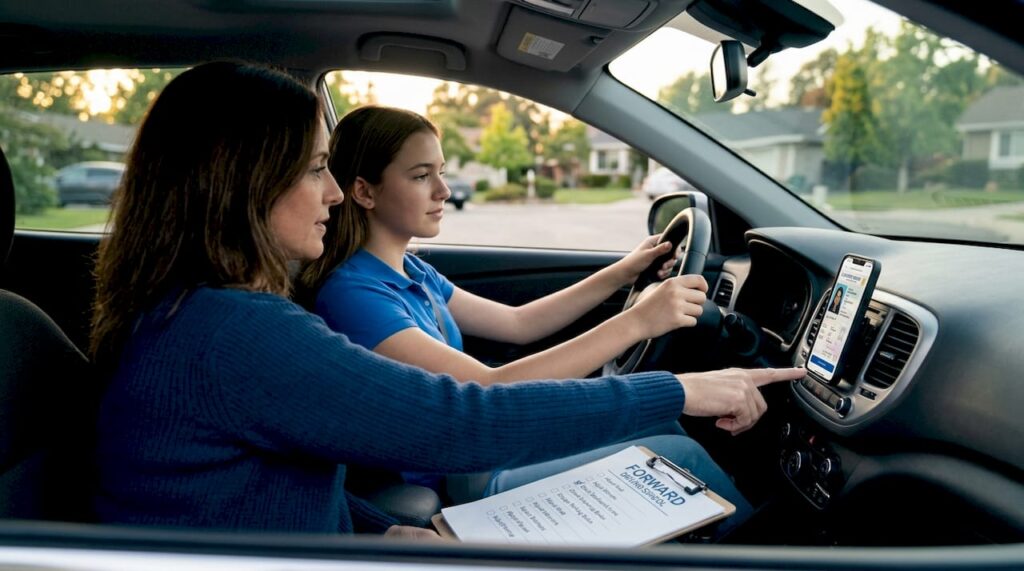
The teen driver education workflow is the structured, sequential process teens and their parents follow to progress from a learner’s permit to a full driver’s license, covering coursework, supervised driving practice, official documentation, and state-mandated testing. The industry standard term for the overarching framework is graduated driver licensing (GDL), and every U.S. state uses some version of it. Research from the Highway Safety Research Center shows that North Carolina’s GDL reduced crashes among 16-year-olds by 38% and serious injuries by 46%. That result comes directly from the structure of the workflow itself, not just from practice time. Understanding each step before you start saves weeks of delays and prevents the paperwork mistakes that stall more families than failed driving tests ever do.
What are the core steps in a teen driver education workflow?
The typical teen driver licensing workflow runs in a fixed sequence. You cannot skip steps, and most states enforce waiting periods between them. Here is how the process unfolds from start to finish.
- Apply for a learner’s permit. Most states require teens to be at least 15 or 16, pass a written knowledge test at the DMV, and provide proof of identity and residency. This is the official entry point into the GDL system.
- Complete driver’s education coursework. States require either classroom instruction or an approved online course. Texas, for example, structures its parent-taught curriculum around 24 hours of classroom content delivered online, while South Carolina mandates specific classroom hours through a licensed school.
- Log supervised driving practice. After coursework, teens must accumulate a minimum number of supervised hours behind the wheel. South Carolina requires 40 hours of supervised driving, including 10 hours at night, all documented on official forms before any licensing test is scheduled.
- Complete behind-the-wheel (BTW) training with a licensed instructor. This is separate from parent-supervised practice. Maryland requires BTW training to be delivered within 18 weeks per state regulation, which means scheduling your instructor sessions early is not optional.
- Pass the knowledge and driving skills tests. The DMV administers both. Failing either requires a retest, which adds another appointment and potentially weeks of waiting.
- Receive the provisional or restricted license. Most GDL systems issue a restricted license first, limiting nighttime driving and passenger counts before a teen earns full driving privileges.
Pro Tip: Print your state’s full GDL checklist on day one and treat it like a project plan. Families who map out every required form, test, and appointment at the start move through the process significantly faster than those who discover requirements one step at a time.
How do supervised driving practice and documentation impact the workflow?
Supervised practice hours are not a formality. They are a legal prerequisite, and incomplete documentation is one of the most common reasons teens get turned away at the DMV.
- South Carolina’s SCDMV Form PDLA (Certification of School Attendance, Driver’s Education, and Driving Practice) must be completed with official signatures before a teen can schedule a road test. Missing or informal entries on this form result in rejected applications.
- Texas’s Parent-Taught Driver Education program requires a separate practice log as part of the PTDE packet. The log must document 44 hours of supervised driving, and the sequence of certificate submissions to the DPS matters. Paperwork sequencing errors in PTDE programs cause more delays than driving skill deficiencies.
- Research from the UK government’s consultation on learner driver periods found that introducing structured logbooks in Queensland increased average supervised practice by 29 hours. More logged hours directly correlate with better-prepared drivers at test time.
- Night driving hours carry special weight. States like South Carolina treat nighttime practice as a distinct requirement, not interchangeable with daytime hours. Families who delay night driving until the final weeks often find themselves scrambling to meet the requirement before a scheduled test.
Pro Tip: Use a shared digital spreadsheet or a dedicated driving log app to track every practice session in real time. Record the date, duration, road conditions, and parent signature. This makes form completion fast and gives you a defensible record if any documentation is questioned.
The role of parents here goes beyond sitting in the passenger seat. You are the compliance officer for this stage of the workflow. Verify entries weekly, confirm night hours are accumulating on schedule, and cross-check your log against your state’s official form before the final submission.

What logistical challenges are common in the teen driver education workflow?
Most families underestimate the administrative load of the teen driver education process. The driving practice is the visible part. The scheduling, paperwork, and appointment management are where workflows stall.
- Multiple DMV visits are standard, not exceptional. North Carolina’s GDL system requires multiple DMV visits for Level 1 and Level 2 testing, and appointment backlogs at busy offices can push test dates back by weeks. Retests add even more visits.
- Dual timelines run simultaneously. Maryland’s 18-week BTW compliance window creates what amounts to two separate clocks running at once: the driving school’s delivery timeline and the DMV’s licensing upgrade timeline. Families who do not schedule BTW training early enough find themselves caught between the two, unable to advance because one clock expired.
- School and work schedules create real conflicts. BTW training sessions are typically offered during business hours or early evenings. Coordinating these with school schedules, extracurricular activities, and a parent’s work calendar requires planning weeks in advance, not days.
- Retest logistics are often overlooked. Failing a knowledge or road test does not just mean studying more. It means rebooking an appointment, potentially waiting several weeks, and in some states, resubmitting documentation. Build retest time into your timeline as a realistic possibility, not a worst case.
- Office closures and limited appointment slots amplify delays. DMV offices in many states operate on reduced hours or by appointment only. Families who wait until all practice hours are logged to start booking tests often find the earliest available slot is a month out.
The fix is straightforward: treat the teen driver licensing workflow as a project with a timeline, not a checklist you work through reactively. Map every required step, estimate how long each takes in your state, and book appointments before you think you need them.
How do parent-taught driver education programs differ in workflow and benefits?
Parent-taught driver education (PTDE) is a state-approved alternative to commercial driving schools where a parent or guardian serves as the primary instructor. Texas runs the most widely referenced PTDE model in the country.
| Feature | Commercial driving school | Parent-taught program (Texas PTDE) |
|---|---|---|
| Coursework delivery | Licensed instructor, fixed schedule | Self-paced online curriculum, parent-led |
| Cost | $300 to $800+ depending on state | $20 PTDE packet plus online course fees |
| Scheduling flexibility | Limited by school availability | Fully flexible around family schedule |
| Certification | School issues completion certificate | DE-964 certificates issued via DPS process |
| Licensing outcome | Full GDL compliance | Identical GDL compliance |
The Texas PTDE workflow begins with purchasing the official packet from a state-approved provider for $20, then completing 24 hours of online classroom instruction and 44 hours of supervised driving practice. The DE-964 certificate is the key document that unlocks the next licensing step at the Texas DPS. Ordering the packet and understanding the certificate sequence before starting saves significant time later.
The primary advantage of PTDE is scheduling control. You practice when it works for your family, in conditions you choose, at a pace that matches the teen’s confidence level. The primary risk is workflow mismanagement. Certificate sequencing errors are the leading cause of delays in PTDE programs, not driving skill gaps.
Pro Tip: If you choose a parent-taught program, read the full certification sequence before ordering anything. Map out which forms go to which agency and in what order. A single out-of-sequence submission can send you back to the start of a step.
For families considering this route, Forwardschool’s resource on teaching teens to drive covers the coaching techniques and safety habits parents need before taking on the instructor role.
What are key tips and common mistakes to avoid in managing the workflow?
The families who move through the teen driver education process without major delays share one habit: they treat the workflow as a system to manage, not a series of events to react to.
- Start with your state’s official GDL requirements, not a general guide. Requirements for supervised hours, coursework format, and documentation vary significantly between states. South Carolina’s 40-hour requirement with 10 night hours is not the same as another state’s standard. Go to your state DMV website first.
- Schedule BTW training before you finish coursework. Instructor availability is limited. If you wait until coursework is complete to start looking for BTW sessions, you may face a multi-week gap. Book early and adjust if needed.
- Treat documentation as a parallel task, not a final step. Fill in practice logs after every session. Do not batch-enter hours at the end. Batch entry introduces errors and makes forms harder to verify.
- Plan for at least two DMV visits per licensing stage. Even if everything goes perfectly, most states require separate visits for the knowledge test and the road test. Build that into your calendar from the start.
- Do not schedule the road test until practice hours are genuinely complete. Rushing to test before sufficient practice is logged is the single most avoidable source of failure and delay. Structured learning periods with documented varied driving experience produce measurably better test outcomes.
- Use digital tools to track progress. A shared Google Sheet, a dedicated app, or even a printed log kept in the car works. The format matters less than the consistency.
“The teen driver education workflow rewards families who plan ahead and penalizes those who improvise. Every delay we see comes from the same source: someone discovered a requirement they didn’t know existed after they thought they were done.”
For a broader look at how the licensing process fits into a teen’s development as a driver, Forwardschool’s guide on the transition to licensed driver covers the behavioral and confidence dimensions that pure workflow management misses.
Key takeaways
A successful teen driver education workflow requires managing coursework, supervised practice documentation, behind-the-wheel training timelines, and DMV appointments as a coordinated system, not a series of isolated tasks.
| Point | Details |
|---|---|
| GDL is the framework | Every U.S. state uses graduated driver licensing; understanding its stages is the starting point. |
| Documentation drives progress | Incomplete or incorrectly sequenced forms are the leading cause of licensing delays, not failed tests. |
| Dual timelines require early scheduling | BTW training deadlines and DMV appointment windows run simultaneously; book both early. |
| PTDE offers flexibility with paperwork risk | Parent-taught programs match commercial schools in outcomes but require strict certificate sequencing. |
| Night driving is a distinct requirement | States like South Carolina treat night hours separately; do not leave them until the final weeks. |
Why the workflow matters more than the driving test itself
I have worked with enough families going through the licensing process to say this plainly: the driving test is rarely where things go wrong. The test is the easy part. What trips families up is everything that comes before it.
The most common pattern I see is a teen who is genuinely ready to drive, whose parent has done everything right behind the wheel, but who shows up at the DMV missing a form, or with a practice log that has informal entries, or who booked a road test before their BTW training window closed. These are not careless families. They are families who treated the process as a driving challenge when it is actually a project management challenge.
The GDL system is complex by design. That complexity exists because it works. The 38% crash reduction in North Carolina is not a coincidence. It is the direct result of graduated exposure, supervised practice, and documented skill-building. Respecting that structure, even when it feels bureaucratic, is what produces a driver who is actually safe on the road.
My honest advice to parents: get involved early, stay involved throughout, and do not assume your teen is tracking the administrative side on their own. And to teens: the workflow is not an obstacle between you and your license. It is the reason your license will mean something when you get it.
— Andre
How Forwardschool simplifies the teen driver education process
Forwardschool has been guiding teens and parents through the driver education process in San Jose, California since 2010. Their structured teen driver courses cover both the knowledge and behind-the-wheel components, with California DMV-registered instructors who understand exactly what documentation and training steps are required at each stage. Forwardschool offers flexible scheduling, free pick-up and drop-off, and dual-brake vehicles so families can focus on progress rather than logistics. Explore the full driver education benefits Forwardschool provides, or go directly to their drivers ed program to see course options and book lessons that fit your teen’s timeline.
FAQ
What is the teen driver education workflow?
The teen driver education workflow is the step-by-step process teens follow from obtaining a learner’s permit through completing coursework, supervised driving practice, behind-the-wheel training, and state testing to receive a driver’s license. It is governed by each state’s graduated driver licensing (GDL) system.
How many supervised driving hours do teens typically need?
Requirements vary by state. South Carolina requires 40 hours of supervised practice including 10 hours at night, documented on official SCDMV forms. Texas’s parent-taught program requires 44 hours of supervised driving logged in the PTDE packet.
What is the biggest cause of delays in the licensing workflow?
Incomplete or incorrectly sequenced documentation causes more delays than failed driving tests. Missing forms, informal log entries, and out-of-order certificate submissions at agencies like the Texas DPS are the most common workflow blockers families encounter.
How does a parent-taught program compare to a commercial driving school?
Both produce the same GDL-compliant licensing outcome. Parent-taught programs like Texas PTDE cost significantly less and offer full scheduling flexibility, but they require strict adherence to certificate sequencing. Commercial schools handle more of the administrative coordination on the family’s behalf.
When should families start scheduling DMV appointments?
Book DMV appointments before you expect to need them, not after. States like North Carolina require multiple DMV visits with known appointment backlogs. Scheduling your knowledge test appointment while still completing coursework is a practical way to avoid multi-week delays between steps.
Recommended
- What Is Teen Driver Education: A Parent-Teen Guide – https://forwardschool.com
- How to Teach Teens to Drive: a Parent’s Guide – https://forwardschool.com
- Driver Education Benefits Every Teen and Parent Should Know – https://forwardschool.com
- Explaining Driver Education Costs: A Parent and Teen Guide – https://forwardschool.com