
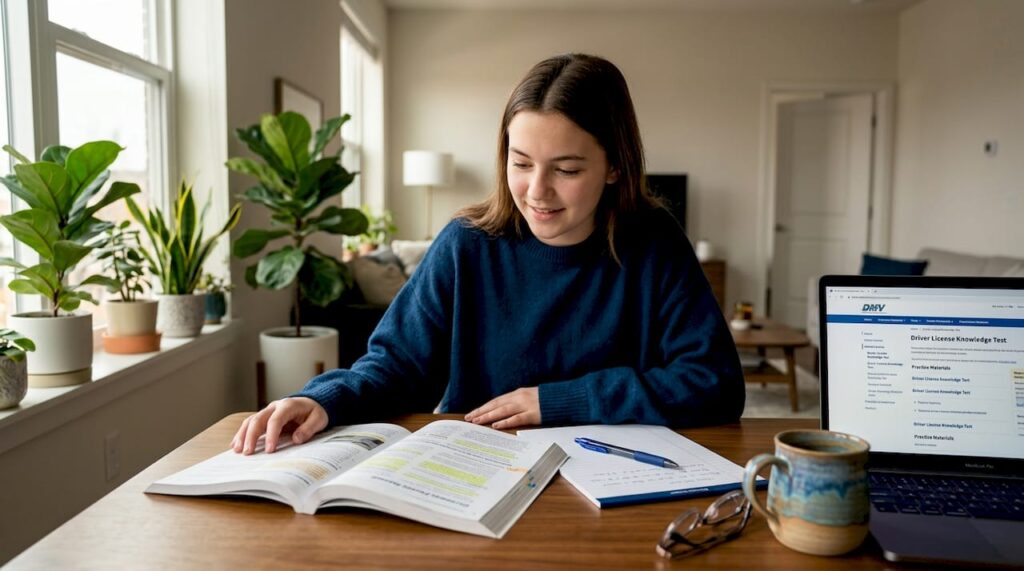
A driving permit is a legally restricted authorization that allows an individual to practice driving under supervision before qualifying for a full driver’s license. Known formally as a learner’s permit or instructional permit, it is the first official step in the graduated licensing system used across the United States. The permit does not grant full driving privileges. It exists to give new drivers, whether teenagers or adults, a structured, supervised window to build real skills before taking on the road alone.
What is a driving permit and how does it differ from a license?
A driving permit is a legally restricted license issued after passing knowledge and vision tests, enabling supervised practice driving. A full driver’s license, by contrast, grants independent driving rights with no supervision requirement. The permit sits at the bottom of a three-stage system: learner permit, provisional license, and full license.

The distinction matters more than most people realize. Driving with a permit but without a qualified supervisor is not just a rule violation. It is an unlicensed driving offense in most states, carrying fines and potential license delays. Parents and teens both need to treat the permit as a conditional document, not a shortcut to independence.
Permit terminology varies widely across states and can confuse learners and parents trying to navigate licensing. California, for example, uses the term “instructional permit” for new drivers and separates that category from commercial permits like Motor Carrier Permits and Temporary Operating Permits. In North Carolina, the document is called a learner permit. In everyday conversation, people use all these terms interchangeably, but each has a specific legal meaning tied to the issuing state.
Types of driving permits at a glance
| Permit type | Who it’s for | Key restriction |
|---|---|---|
| Learner’s / instructional permit | Teen and adult new drivers | Must drive with licensed adult supervisor |
| Provisional license | Drivers who passed road test | Limited night driving, passenger limits |
| Commercial learner’s permit (CLP) | CDL candidates | Must drive with CDL holder in cab |
| Temporary Operating Permit | Drivers awaiting full license delivery | Short-term, state-specific conditions |
The learner’s permit is the type most teens and adult beginners encounter. Commercial and temporary permits serve narrower legal purposes and are not part of the standard new-driver path.
What are the requirements to get a driving permit?
Most states set the minimum age for a learner’s permit at 15 or 16, though some allow applications as young as 14 with restrictions. Age is the starting point, but it is far from the only requirement. Here is what the process typically involves:
- Meet the minimum age. Check your state’s DMV website for the exact cutoff. In California, the minimum age is 15 and a half.
- Pass a written knowledge test. This covers traffic laws, road signs, and safe driving practices. North Carolina, for instance, requires knowledge, vision, and road sign tests before issuing a permit.
- Pass a vision exam. The learner permit serves as a checkpoint to confirm vision capabilities before engaging in real-world driving. Most states require a minimum corrected visual acuity.
- Provide proof of identity and residency. Acceptable documents typically include a birth certificate, Social Security card, and two proofs of state residency such as utility bills or school records.
- Submit parental or guardian consent. Applicants under 18 must have a parent or legal guardian sign the application at the DMV office.
- Pay the application fee. Fees range from roughly $10 to $35 depending on the state.
Adult learners follow the same core steps but do not need parental consent. The knowledge test content is identical regardless of age. One practical difference: adults often have more flexibility in scheduling DMV appointments and may find the written test easier after years of observing traffic patterns as passengers.
Pro Tip: Study your state’s official driver handbook, not third-party summaries. The DMV knowledge test pulls questions directly from that handbook, and the official version is always free online.
After passing, North Carolina mails the permit within 20 days. Many states issue a temporary paper permit on the spot while the physical card is processed. Keep that paper document with you every time you drive.
For a detailed breakdown of California-specific steps, the California driving requirements guide from Forwardschool walks through identity, vision, and knowledge testing in sequence.
How does supervised driving work with a permit?
Supervised driving is the entire point of the permit stage. The legal requirement is not just that an adult is present in the car. The supervisor must meet specific qualifications, and those qualifications vary by state.
Georgia requires that the supervising driver be a licensed adult over age 21 certified to drive Class C vehicles, seated directly beside the learner. North Carolina specifies that the supervisor must sit beside the learner and hold a license valid for the vehicle class being operated. A parent with only a Class C license cannot legally supervise a teen practicing in a vehicle that requires a different class.
Common supervision rules across most U.S. states include:
- The supervisor must be seated in the front passenger seat, not the back seat.
- The supervisor must hold a valid, unexpired driver’s license.
- Many states require the supervisor to be at least 21 years old.
- The permit holder may not drive alone under any circumstances, including emergencies.
- Some states restrict permit driving to daylight hours or specific road types during the early weeks.
Beyond the legal requirements, the quality of supervision matters enormously for skill development. A supervisor who gives clear, calm instructions builds a learner’s confidence. One who grabs the dashboard and shouts creates anxiety that transfers directly into poor driving habits. Forwardschool’s instructors are trained specifically in what effective instruction looks like during supervised sessions, which is a skill most parents have never formally developed.
Pro Tip: Before each supervised practice session, agree on a specific skill to focus on, such as highway merging or parallel parking. Unfocused practice builds mileage but not necessarily competence.
One restriction many learners overlook: cell phone use behind the wheel is prohibited for permit holders in California, even hands-free. The rules for permit holders are stricter than those for licensed adults in several states.
What is the graduated licensing process?
The graduated licensing system moves new drivers through three stages before granting full privileges. The permit is stage one. Each stage adds driving freedom while reducing supervision requirements, and each transition requires meeting specific time and testing conditions.
Transitioning from permit to provisional license includes mandatory holding periods and practical driving hours designed to build skill before unsupervised driving begins. In California, teens must hold an instructional permit for at least six months and complete 50 hours of supervised driving, including 10 hours at night, before taking the behind-the-wheel test for a provisional license.
| Stage | Name | Key condition to advance |
|---|---|---|
| Stage 1 | Learner’s permit | Pass knowledge and vision tests; hold permit for required period |
| Stage 2 | Provisional license | Pass road test; complete required supervised hours |
| Stage 3 | Full driver’s license | Hold provisional license for required period; no major violations |
The provisional license stage still carries restrictions. In most states, provisional drivers cannot carry passengers under 20 years old for the first 12 months and face strict nighttime driving limits. These restrictions exist because graduated licensing is designed to reduce crashes among new drivers by limiting exposure to high-risk conditions before skills are fully developed.
For a full picture of how the stages connect, Forwardschool’s resource on teen driver progression explains each milestone from permit to full license in practical terms.
Key takeaways
A driving permit is a supervised-only authorization that starts the graduated licensing process, and skipping its requirements carries legal consequences, not just delays.
| Point | Details |
|---|---|
| Permit vs. license | A permit requires a licensed adult supervisor present; a full license grants independent driving rights. |
| Core requirements | Pass knowledge and vision tests, provide identity documents, and meet the minimum age set by your state. |
| Supervision rules | The supervisor must sit beside the learner and hold a valid license for the vehicle class being driven. |
| Graduated stages | Permit holders advance to provisional and then full license by meeting time, hour, and testing requirements. |
| Terminology varies | States use different names (learner’s permit, instructional permit) but the legal function is the same. |
What I’ve learned from watching hundreds of learners start with a permit
Most people treat the permit stage as a waiting room. They want to get through it as fast as possible and move on to the real license. That mindset is the single biggest mistake I see, and it costs learners months of progress.
The permit period is the only time a new driver has a qualified adult beside them with no pressure to perform independently. That is not a limitation. It is a training advantage that disappears the moment the provisional license arrives. Learners who use those supervised hours deliberately, practicing in rain, on highways, in parking structures, come out of the permit stage as noticeably better drivers than those who just log miles on familiar routes.
I also see parents underestimate how much their own driving habits influence their teen. If you brake late, roll through stop signs, or check your phone at red lights, your teen has watched you do that for years. The permit stage is a good time for parents to audit their own habits before they become the standard their teen learns against.
One misconception worth addressing directly: the permit is not a formality. States designed knowledge tests to screen out applicants who do not understand basic traffic law. Failing that test is not embarrassing. It is the system working correctly. Teens who fail once and study more carefully before retesting consistently outperform those who barely passed on the first attempt.
Use the permit stage fully. It is the cheapest, safest, most supported driving education you will ever get.
— Andre
Start your permit journey with Forwardschool
Forwardschool has helped teens and adults in San Jose prepare for their driving permits and licenses since 2010. Their driver education courses cover everything from California traffic law to behind-the-wheel practice in DMV-registered vehicles with dual brake pedals. For learners preparing for the knowledge exam, the online knowledge exam prep tool lets you practice at your own pace before your DMV appointment. Parents looking to understand the full scope of what driver education provides can explore the benefits of driver education for teens and families. Forwardschool offers free pick-up and drop-off, flexible scheduling, and qualified instructors who know exactly what California DMV examiners look for.
FAQ
What is a driving permit in simple terms?
A driving permit is an official document that lets you practice driving legally, but only with a licensed adult supervisor in the vehicle. It is the first step toward earning a full driver’s license.
How old do you have to be to get a driving permit?
Most U.S. states set the minimum age at 15 or 16, though some states allow applications at 14 with additional restrictions. California requires applicants to be at least 15 and a half years old.
What tests are required to get a driving permit?
Applicants must pass a written knowledge test covering traffic laws and road signs, plus a vision exam. North Carolina also includes a road sign recognition test as part of its permit application process.
Who needs a driving permit?
Anyone learning to drive for the first time, whether a teenager or an adult, must obtain a learner’s permit before practicing on public roads. This applies to new residents with no prior U.S. license history as well.
How long do you have to hold a driving permit before getting a license?
Requirements vary by state. California requires a minimum of six months plus 50 hours of supervised driving before a teen can test for a provisional license. Adult applicants in some states face shorter holding periods.
Recommended
- How to Teach Teens to Drive: a Parent’s Guide – https://forwardschool.com
- What Is Teen Driver Education: A Parent-Teen Guide – https://forwardschool.com
- Driving lesson policy: A California parent’s guide – https://forwardschool.com
- Why Take Driving Lessons: Teens and Adults Guide – https://forwardschool.com