
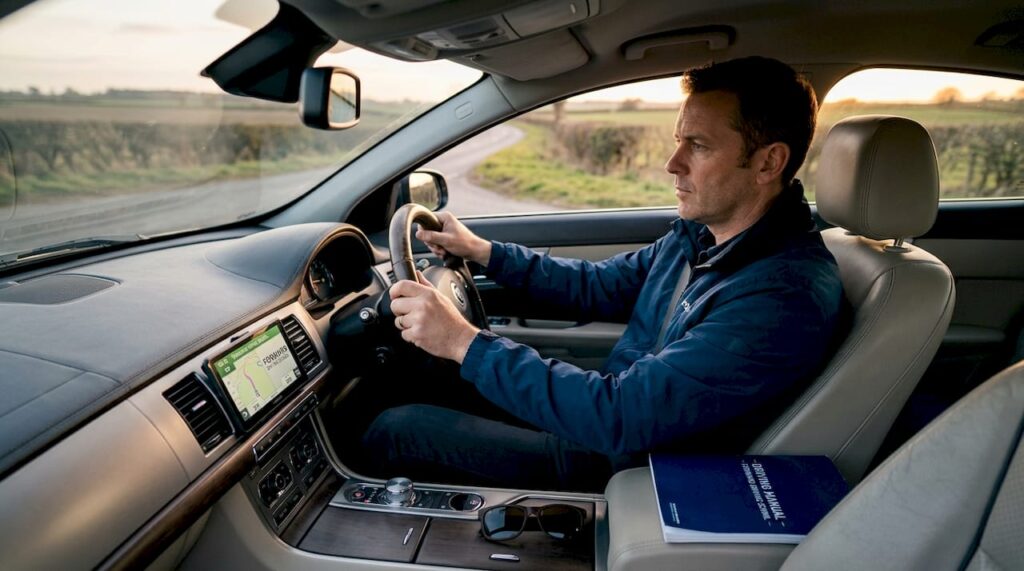
Adult driving tips are proven, practical strategies that directly improve your safety, reaction time, and control behind the wheel. Whether you have been driving for five years or thirty, the habits you practice daily determine how safe you are on the road. Most crash-contributing factors are driver-controlled, including speed, lane changes, and distraction. That means you have more influence over your safety than road conditions or other drivers ever will.
1. Adult driving tips start with proper following distance
The single most effective habit you can build is maintaining a safe following distance. AAA recommends the 3- to 4-second rule: when the car ahead passes a fixed roadside object like a sign or a tree, count the seconds before your car reaches the same point. If you reach it in fewer than three seconds, you are too close. This method is far more reliable than the old “one car length per 10 mph” guideline because it automatically adjusts for your speed.

Proper following distance does more than prevent rear-end collisions. It reduces the need for sudden braking, which lowers your stress level and gives you time to read the road ahead. In heavy traffic, drivers who maintain spacing also tend to smooth out the stop-and-go effect that causes phantom traffic jams.
Here is what to practice on your regular commute:
- Pick a fixed object on the side of the road, such as a utility pole or road sign
- Watch the car ahead pass it, then start counting: “one-one-thousand, two-one-thousand, three-one-thousand”
- If you pass the object before finishing the count, ease off the accelerator
- In rain, fog, or at night, extend your count to five or six seconds
Pro Tip: Practice the timing method on familiar routes first, where you are not distracted by navigation. Once it becomes automatic there, it transfers naturally to unfamiliar roads.
2. Why regular eye exams matter more than you think
Vision is the primary sense you use while driving, yet most adults only check their eyesight when something feels obviously wrong. The American Academy of Ophthalmology (AAO) recommends that adults under 40 get an eye disease screening every five to ten years to establish a baseline for conditions like glaucoma, cataracts, and diabetic retinopathy. These conditions develop slowly and can impair your driving well before you notice any symptoms.
A standard DMV vision test only checks basic visual acuity. It does not detect peripheral vision loss, contrast sensitivity decline, or early-stage glaucoma. All three of those conditions directly affect your ability to spot hazards, judge gaps in traffic, and drive safely at night.
For adults over 65, the stakes are higher. Older adults should get vision checked yearly because age-related changes in the eye affect night vision, glare sensitivity, and reaction time. Each of those factors compounds your crash risk in low-light conditions.
A comprehensive adult medical eye evaluation goes beyond a lens prescription. It includes an ocular health assessment that can catch problems affecting your driving even when your corrected vision tests at 20/20. Talk to your eye care professional about the right screening interval for your age and health history.
3. How refresher driving courses rebuild your confidence fast
Self-teaching has real limits. You can read articles and watch videos, but you will reinforce your existing habits, including the bad ones, without structured feedback. AAA’s 6-hour defensive driving course covers safe driving practices, car maintenance, updated road laws, and new vehicle technology. The format includes breaks and lunch, making it manageable for working adults to complete in a single day.
Refresher courses integrate updated rules and vehicle technology alongside skill review, which makes them more efficient than scattered self-study. You learn what has changed in traffic law, how modern driver-assist systems work, and how to handle situations that rarely come up in daily driving but matter enormously when they do.
Key benefits of structured refresher training include:
- Threat recognition drills that sharpen your hazard awareness
- Updated guidance on hand position, following distance, and merging technique
- Car maintenance basics that directly affect safety, including tire pressure and brake checks
- Instruction on using backup cameras, lane-assist systems, and blind-spot monitors correctly
Pro Tip: Choose programs registered with your state’s DMV or affiliated with recognized organizations like AAA. Forwardschool’s adult refresher driving lessons are a strong option for drivers in the San Jose area who want structured, instructor-led training.
4. Using technology to drive safer, not just smarter
Navigation apps like Google Maps, Waze, and Apple Maps do more than show you the fastest route. Route apps help avoid congestion and reduce stress, which directly improves your decision-making behind the wheel. A driver who knows what is ahead stays calmer and reacts more deliberately than one who is surprised by sudden slowdowns or unexpected lane closures.
Driver-assist features built into modern vehicles offer real safety benefits when used correctly. Backup cameras reduce blind-spot collisions in parking lots. Lane-keep assist catches micro-drifts during highway fatigue. Blind-spot monitors flag vehicles in your peripheral zone. The key word is “assist.” These systems are designed to support your attention, not replace it.
The risk with technology is overreliance. Drivers who trust their GPS too completely stop reading road signs. Drivers who rely on lane-assist stop actively steering. When these systems fail or encounter edge cases, an inattentive driver has no backup. Use technology as a second layer of awareness, not as a substitute for it.
Maintaining proper tire pressure is one of the simplest technology-adjacent habits you can build. Underinflated tires increase stopping distance and reduce stability in turns. A monthly pressure check takes two minutes and costs nothing.
5. Common driving mistakes adults should avoid
Distracted driving is the most widespread and preventable cause of accidents. Phone use while driving is the obvious culprit, but eating, adjusting the radio, and extended conversations with passengers all pull your attention off the road. Even a two-second glance at a phone at highway speed means you have traveled the length of a basketball court without watching where you are going.
Hand position is another area where many adults are working from outdated training. AAA now recommends the 9 and 3 position on the steering wheel, not the old 10 and 2. Modern airbags deploy upward through the center of the wheel. Hands at 10 and 2 can be thrown into your face during deployment. The 9 and 3 position keeps your arms clear and gives you better rotational control.
The table below compares the most common adult driving mistakes with their practical fixes:
| Common mistake | Practical fix |
|---|---|
| Following too closely | Apply the 3- to 4-second timing rule on every drive |
| Phone use while driving | Enable Do Not Disturb mode before starting the car |
| Outdated hand position (10 and 2) | Switch to 9 and 3 for airbag safety and better control |
| Skipping annual vision checks | Schedule yearly eye exams, especially after age 65 |
| Ignoring tire pressure | Check pressure monthly and before long trips |
| Overrelying on driver-assist tech | Treat all assist features as supplements, not replacements |
Night driving and bad weather deserve specific attention. Reduced visibility, wet roads, and glare from oncoming headlights all demand a lower speed and greater following distance than you would use in daylight. Seatbelt use for rear-seat passengers is also a common oversight. An unbelted rear passenger becomes a projectile in a collision, endangering everyone in the vehicle.
Key takeaways
Safer adult driving comes from measurable, repeatable habits, not from vague caution. The most effective improvements are the 3- to 4-second following distance rule, annual eye exams, structured refresher training, and disciplined technology use.
| Point | Details |
|---|---|
| Follow the 3- to 4-second rule | Time your distance using a fixed roadside object, not car lengths. |
| Get regular eye exams | AAO recommends screenings every 5 to 10 years before age 40, and yearly after 65. |
| Take a refresher course | Structured programs like AAA’s 6-hour course update skills faster than self-study. |
| Use technology as a tool | Apps and driver-assist features support attention but never replace it. |
| Fix common mistakes first | Update hand position to 9 and 3 and eliminate phone use before anything else. |
What I have learned from watching adults relearn to drive
I have seen hundreds of adult drivers walk into a refresher course convinced they only need a quick tune-up. Most of them discover within the first hour that their following distance is half of what it should be, their hand position is outdated, and they have never once thought about how their vision has changed since they first got their license. That is not a criticism. It is just what happens when a skill becomes automatic. You stop examining it.
The drivers who improve the fastest are not the ones who were worst to begin with. They are the ones who treat driving as something worth measuring. They count seconds instead of guessing at distance. They schedule their eye exam the same way they schedule an oil change. They take a refresher course not because they had an accident but because they want to stay ahead of one. That mindset is the real differentiator.
The technology piece is where I see the most overconfidence. Drivers who have lane-assist and backup cameras often feel safer than drivers without them, and statistically that confidence is not always warranted. The feature works until it does not, and the driver who has been passively relying on it is the least prepared for that moment. Stay engaged. Use the tools. Do not let the tools use you.
If you are an adult driver who wants to retake driving lessons for confidence, the research is clear: structured training with qualified instructors produces faster, more lasting results than any amount of solo practice.
— Andre
Ready to sharpen your skills with Forwardschool?
Forwardschool has been training adult drivers in San Jose, California since 2010. Their adult refresher driving lessons cover everything covered in this article and more: updated road rules, defensive driving techniques, car maintenance basics, and hands-on practice with an experienced instructor. Every vehicle is equipped with dual brake pedals, and scheduling is flexible to fit working adults.
If you are not sure which program fits your situation, the 2026 driving course guide breaks down every available option so you can choose with confidence. Forwardschool is registered with the California DMV and offers free pick-up and drop-off throughout the San Jose area.
FAQ
What is the safest following distance for adult drivers?
AAA recommends a 3- to 4-second following distance, measured by counting the seconds between when the car ahead passes a fixed object and when you reach the same point. In rain, fog, or at night, extend that gap to five or six seconds.
How often should adult drivers get their eyes checked?
The American Academy of Ophthalmology recommends an eye disease screening every five to ten years for adults under 40, and yearly for adults over 65. Standard DMV vision tests do not detect conditions like glaucoma or cataracts that affect driving safety.
Are refresher driving courses worth it for experienced adults?
Yes. AAA’s 6-hour defensive driving course updates drivers on current road laws, vehicle technology, and safe driving practices more efficiently than self-study. Structured courses also provide instructor feedback that solo practice cannot replicate.
What is the correct hand position on the steering wheel?
AAA now recommends the 9 and 3 position, not the traditional 10 and 2. Modern airbags deploy upward through the steering wheel center, and hands at 10 and 2 can be struck during deployment. The 9 and 3 position keeps your arms clear and improves steering control.
Can navigation apps actually make driving safer?
Google Maps, Waze, and Apple Maps reduce stress by helping you anticipate traffic and plan routes in advance. Less stress means better decision-making. The risk is using them as a distraction rather than a planning tool, so always set your route before you start driving.